Service 03 of 04 · Chandler, AZ
Pavers and Patios in Chandler, AZ
Last updated
You want a patio you will actually sit on, or a walk that ends the dust and the mud. Tell us the size and the look you like, and someone from our team will call you back to plan the base, the pavers and the edges.
See price rangesA paver patio in Chandler is built from the base up, and the base is what keeps it flat through monsoon season. Patios, walkways, pool decks and retaining walls go in using travertine and concrete pavers, with the slope set to move water away from the house.
01Hardscape
What does a paver patio installation include in Chandler?
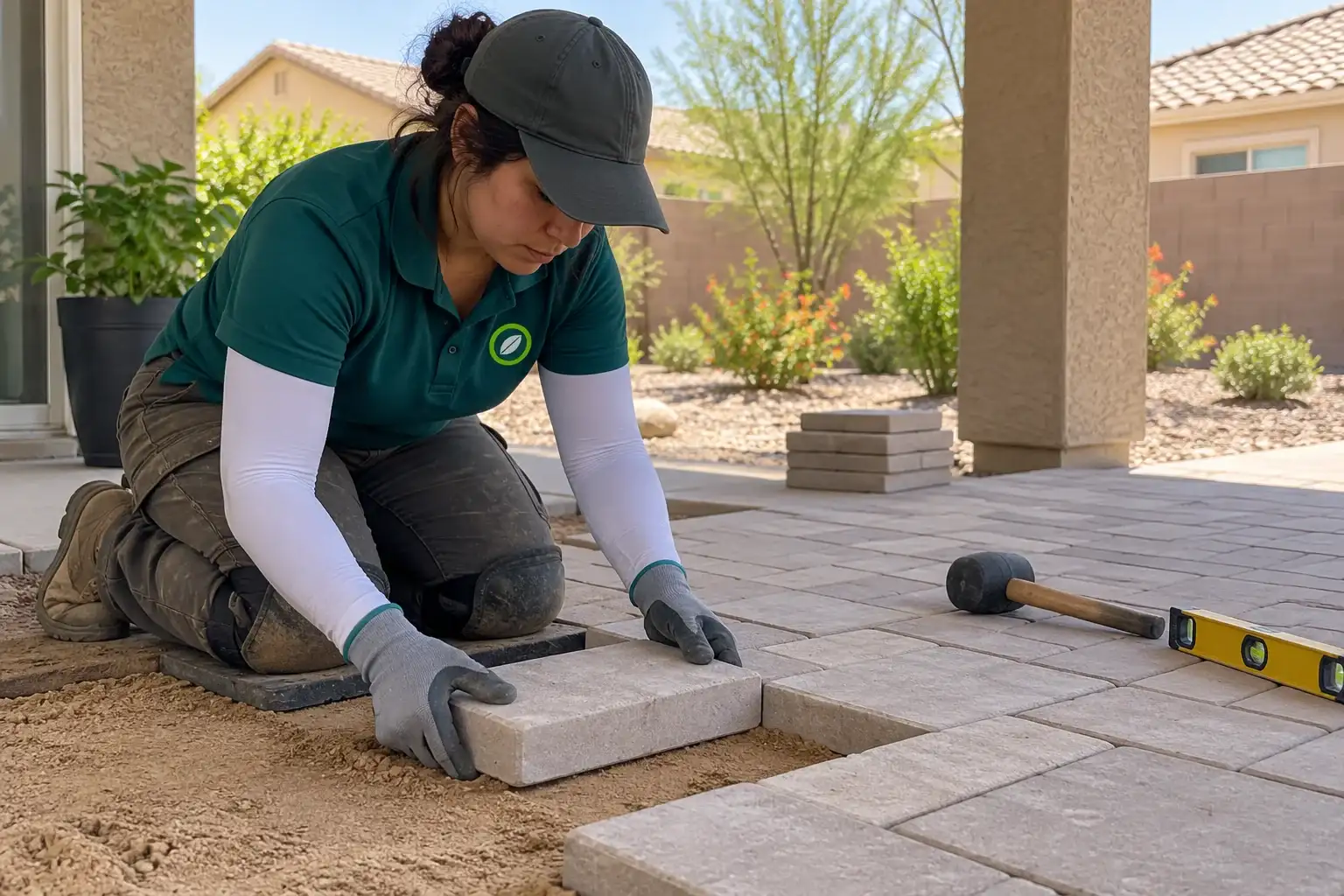
The build includes excavation, a compacted aggregate base, a leveling bed, the pavers, edge restraint and a joint sand. Excavation goes deep enough to hold the base and the paver, and the base goes in lifts that are watered and compacted one at a time. The slope is set before a single paver is laid, because the patio has to shed water away from the wall and toward a safe outlet. Cuts around the house, the walls and any drain are made with a saw, and the edge is locked with a restraint so the field cannot spread. Joints are filled with a polymeric sand that sets up and resists washout. On a walkway the same build applies at a narrower width, and on a retaining wall the base and the drainage behind the wall carry the load.
02Costs
What does a paver patio cost in Chandler?
Published national data puts a paver patio at about $3,800 for 280 square feet, with a range of $480 to $22,500 and $8 to $50 per square foot, per a national cost guide, 2026. The bottom of that range is a small pad of about 60 square feet, and the top is a very large patio, with the $22,500 figure covering 900 square feet, or a premium stone such as flagstone at up to $50 per square foot. Material sets a lot of the spread: travertine and thicker concrete pavers cost more than a standard concrete paver, and a herringbone pattern with many cuts takes longer than a running bond. Access matters too, since a back yard reached by wheelbarrow takes more hours than one a machine can reach. These are published national ranges, not a quote. The final price comes after someone sees the yard.
03Planning
What does the work look like start to finish?
The work starts with a layout on the ground, so you can stand where the patio will be and see the size before anything is cut. The ground is excavated, the spoil is hauled off, and base rock goes in lifts, compacted and checked for slope as it goes. Once the base passes, the setting bed goes down and the pavers are laid from a string line. Cuts are made at the edges, the restraint is pinned, and the polymeric sand is swept into the joints and set with water. The finished surface is checked with a level, and water is run on it to see where it goes. The last step is a cleanup and a walkthrough. Call (747) 243-2089 to ask about a measure and a layout.
04Hardscape
What is different about pavers in a Chandler yard?
Caliche, heat and monsoon runoff decide most of the detail here. Caliche, a cemented layer that is a common problem in southern Arizona soils (UA Extension, managing caliche (opens in a new tab)), may need to be broken before a base can be compacted, and a base that skips that step can leave a patio that rocks within a season. Surface heat matters in July, so lighter travertine and lighter concrete colors stay more comfortable underfoot than a dark charcoal paver in full sun. The monsoon arrives with short intense storms, and a patio that slopes toward the house or toward a wall pushes water into the stucco and the foundation. Chandler sits in zone 9b with 25 to 30 F extremes on the 2023 map (USDA plant hardiness map (opens in a new tab)), so the base and the joint sand have to handle a cold night as well as a hot one.
05Planning
What should I have ready before the first visit?
Have the plot plan, the HOA rules and a rough idea of the size. The plot plan shows setbacks and easements, which decides where a patio can legally sit and where a retaining wall can go. The HOA packet covers approved materials, colors, wall heights and whether a submittal is required, and it is worth reading before you fall in love with a paver. Have a note of where water stands after a storm and which direction the yard drains. Decide whether you want a seat wall, steps or a fire feature, since those change the base and the layout. Clear access for the work and the material, and mark any irrigation lines or utility boxes in the footprint. Photos of the yard from an upper window help with the layout.
06Hardscape
What goes wrong if pavers are installed badly?
Bad paver work shows up as movement, water and weeds. A base that is too thin or not compacted lets the field settle, and the patio develops a dip that holds water. A slope set toward the house sends monsoon runoff into the wall. No edge restraint lets the outer row spread, and the joints open. Joint sand that is not set washes out in the first storm and leaves the pavers loose. Cuts made without a saw can leave chips and gaps that stay open. A retaining wall built without drainage behind it can bulge after a wet season. Weeds come up through the joints when the base was never properly graded. Each of these is a base or a drainage failure, not a paver failure.
07Timeline
How long does a paver project take?
The size of the field, the number of cuts and the drainage detail set the schedule. Excavation and base work are the slow part, because the rock goes in lifts and each lift has to be watered and compacted before the next one. A patio with a wall, steps or a drain takes longer than a flat pad of the same size. Cutting travertine and fitting it around a curved edge adds time, and so does access, since a narrow gate turns a machine job into a wheelbarrow job. The polymeric sand needs to set before the area takes traffic. The order of work and the days that need water and power are set out up front, and dates are confirmed once the layout is approved.
08Hardscape
What maintenance do pavers need after?
Pavers need little beyond sweeping and a refill of the joints. Sweep off leaves and grit so the surface does not stain, and rinse with a hose rather than a pressure washer on full, which can blow out the joint sand. Check the joints twice a year and top up the polymeric sand where it has worn. Pull weeds while they are small. After a monsoon, walk the edge and look for any paver that has lifted or any wall that has moved. A sealer is optional, and on travertine it changes the look, so test a small area first. If a paver does crack, it can be lifted and replaced without rebuilding the patio, which is one reason the material is used here.
09Costs
Can a patio be built in stages to spread the cost?
Yes, and the usual split is the main patio first, then the walkway, then a wall or a shade structure. The stage line has to be planned at the layout stage, because the base needs a clean edge to stop at and the restraint has to be placed at the temporary edge. Building the base for the whole area in one pass and paving the part the budget covers is the cleaner option, since it keeps the slope continuous. If a wall is coming later, set the footings and the drainage now. Keep the same paver, color and thickness for both phases, because the same product from a different run can differ in tone. Write the stage line into the layout so both phases share one slope, and set the restraint at the temporary edge so the field cannot spread before phase 2.
10Costs
What is the difference between pavers and the cheaper version?
The cheaper version is usually a concrete slab or a thin overlay, and the difference is in how it fails. A slab is one piece, so when the ground moves it cracks, and a repair means breaking out a section. Pavers are individual units on a compacted base, so a settled or damaged paver can be lifted and reset. A thin overlay over an existing slab depends entirely on what is underneath, and it can telegraph the cracks in the slab within a season. Stamped concrete imitates the look but not the behavior. Ask what happens when a utility line under the patio has to be reached later, and the price difference starts to make sense. The other difference is repairability. A cracked paver can be lifted and reset, while a cracked slab is a project.
11Hardscape
Which Chandler neighborhoods do you cover for pavers?
We serve Chandler and the towns around it. That includes Ocotillo and the south Chandler communities in ZIP codes 85248 and 85249 (Ocotillo), where pool decks and covered patios are common, and the older west side neighborhoods in 85224, 85225 and 85226 (West Chandler), where a new patio often replaces a cracked slab. Coverage also includes the historic blocks near the square (Downtown Chandler), where small front yards and narrow side access change the approach. Gilbert, Mesa and Tempe are covered too. On any job outside Chandler, confirm that city's water rules before changing an irrigation controller. If the property line is unclear, the plot plan settles it before any base is dug. Send the ZIP code, and someone from our team will call you back about which set of rules applies to the address, since a patio near a boundary can fall under 2 sets of review.
125 questions
Questions people ask
Still have a question? Call (747) 243-2089 and describe the yard.
01Do pavers get too hot to walk on in Chandler?
They can in July and August, especially a dark paver in full afternoon sun. Lighter travertine and lighter concrete colors stay cooler, and shade from a pergola or a tree makes a big difference. A pool deck is worth planning with heat in mind, since bare feet and a west facing surface are a bad combination at 4 in the afternoon.
02How thick should the base be for a patio?
It depends on the soil and the use, and no single number fits every yard. Caliche, fill dirt and an old slab each call for a different detail. What matters is that the base is excavated to the right depth, placed in lifts, watered and compacted, and that the slope is checked before the pavers go down. The base detail belongs in the written scope.
03Can pavers be laid over an existing concrete slab?
Sometimes, and it depends on the slab. A sound slab with the right slope can take a setting bed and pavers, which raises the finished height at the doors and the walls. A cracked or settled slab will telegraph its problems through the new surface. Thickness at the thresholds, the height of the weep screed and the drainage all have to be checked before that route is chosen.
04Do I need a permit for a patio or a retaining wall?
Some projects do and some do not. Chandler's homeowner building permit manual (opens in a new tab) says a retaining wall up to 4 feet tall, measured from the bottom of the footing, needs no building permit unless it supports a surcharge, while a taller wall that holds back earth, or a fence on top of a retaining wall, needs one. Every fence or wall needs zoning clearance whatever its height, and a patio cover goes through a permit after a talk with a city planner about setbacks. Ask the city before the base is dug, not after.
05How do I keep weeds out of the paver joints?
Weeds root in the sand, so the first answer is a full joint. Polymeric sand that is properly set leaves less room for seed, and a base that was graded and compacted correctly stops weeds coming from below. Sweep regularly, pull weeds while they are small, and top up the joints when they wear down. Avoid washing the joint sand out with a pressure washer.