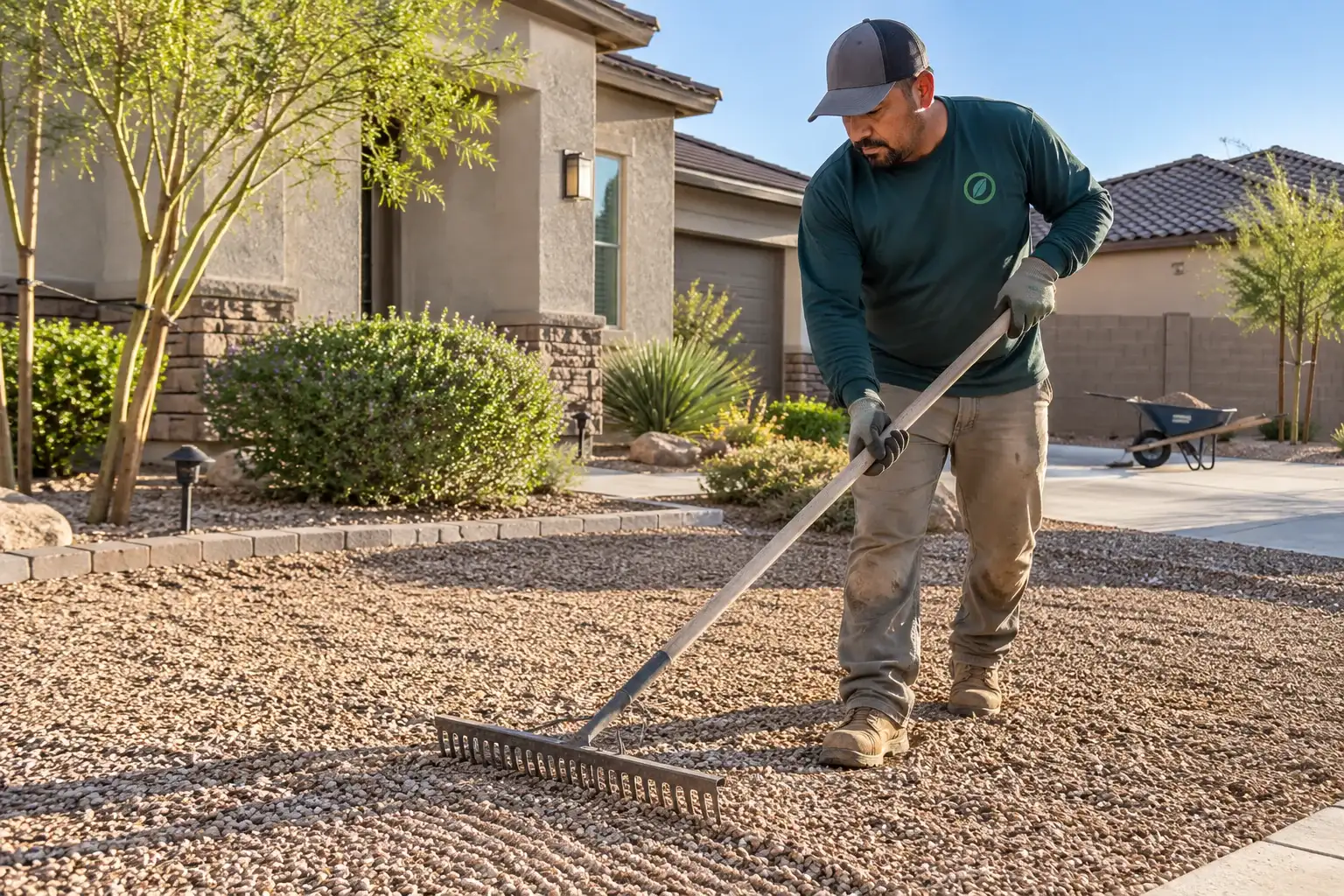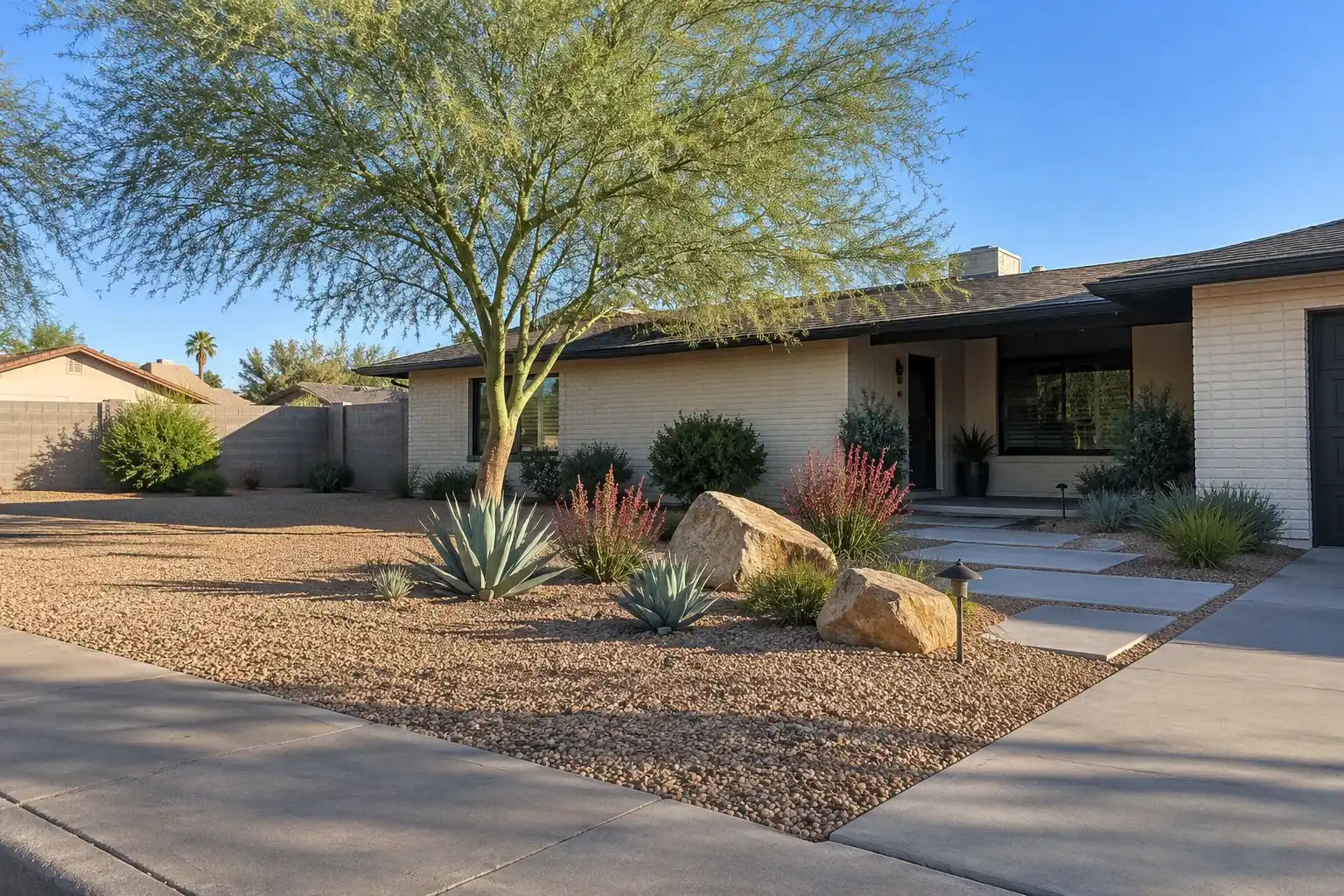
Guide 05 · 4 min read
Pavers vs Concrete Patio in Chandler, AZ
Concrete is one poured slab, cheap and prone to cracking when the ground moves. Pavers are individual pieces that flex at the joints instead. On Chandler's expansive clay and caliche, that difference decides which patio survives.
All yard guidesGood to know
The short answer
If you want the lowest first cost and a smooth, even surface, concrete. If the patio has to survive soil movement, summer heat, and a monsoon season without cracking, pavers. Concrete cracks and shows it. Pavers move and hide it. The right choice depends on the soil, the base prep, and what the lot does with storm water.
Hardscape
Pavers: what they actually are
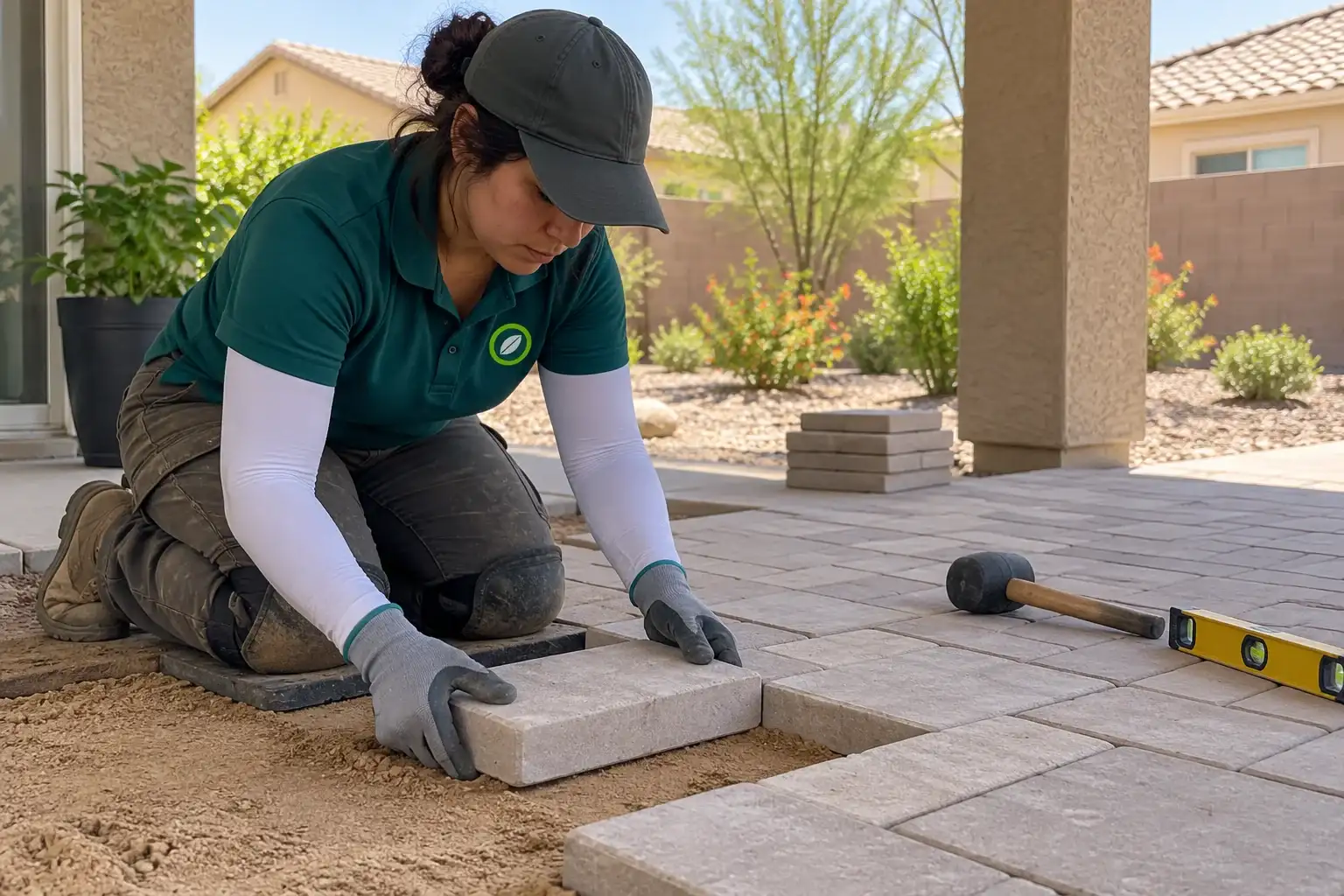
Pavers are individual units, concrete, brick, or travertine, set one by one on a compacted base of gravel and sand. The joints between them are the point. When the ground swells or settles, the joints open and close a fraction and absorb the movement, so the units themselves do not crack. A damaged paver can be lifted and replaced without touching the rest of the patio.
Pavers only work as a system. The base has to be compacted in lifts, the bedding sand has to be screeded level, and the edges need a hard restraint or the outer units walk outward over time. Skip the restraint and the patio migrates, one paver at a time. The units themselves are almost always concrete, and the color runs through the whole piece, which is why a chipped paver still reads the same color. That is the quiet advantage over a slab: damage stays local, and one unit is a repair, not a resurfacing.
Hardscape
A concrete patio: what it actually is
A concrete patio is one monolithic pour, mixed, placed, and finished in a single day, with control joints cut or tooled into the surface. Those joints are deliberate weak lines meant to tell the slab where to crack. It works, mostly, but the slab is one piece, and one piece cannot flex.
Concrete is strong in compression and weak in tension, which is why it cracks when the ground moves under it. In a climate with expansive clay, the crack is not a defect in the work. It is the material doing what it does. The question is where the crack lands and whether it runs through the whole patio.
Hardscape
Where pavers fail here
Pavers fail on the details in Chandler, and the details are specific. Monsoon rain moves sand out of the joints, so the joints start washing and the units begin to rock underfoot. Without edge restraint and compaction, granite and paver sand walk out of the patio toward the pool, the driveway, and the neighbor's yard, the same migration that hits rock beds. Ants love the bedding sand and push it up through the joints overnight. Then there is the heat itself. A dark paver patio in July is a hot surface, and the sand joints hold heat the way the units do. Shade and light colors matter more than the paver brand, and in a yard with no shade the patio goes unused between noon and sundown for half the year.
Caliche matters here too. Chandler's newer subdivisions sit on it, and a paver base built over unexcavated caliche traps water underneath. The patio looks fine, then the first monsoon ponds it, and the base heaves unevenly. The paver surface hides the movement, but a heaving base under pavers eventually shows as waves and dips across the patio.
Hardscape
Where a concrete patio fails here
A concrete patio fails where the ground moves, and the ground moves in the East Valley. Expansive clay swells when it is wet and shrinks when it is dry, and the monsoon cycle loads the slab twice a year. Control joints help, but cracks still find their own path, and a crack running across a patio is permanent. There is no fixing it short of sawing out the section, and the patch never matches.
Grade matters more with concrete because the slab is one piece. A patio poured a half inch too high pushes monsoon runoff toward the house or the neighbor's wall, and the water has no joints to escape through. In HOA-governed Chandler neighborhoods, a patio is also visible work: some master-planned communities require design review for hardscape, and the approval is supposed to come before the pour, not after. A concrete patio in Chandler also lives or dies by the pour timing. A slab placed on a hundred-and-ten-degree afternoon cures too fast, the surface dries before the body does, and the micro-cracks start before the first monsoon. Nobody pours in July on purpose, which is why the careful crews schedule around the heat and the cheap bids do not.
Scope
What it costs and what drives the number The driver on both is the base: how deep the dig goes, whether caliche shows up, and how much gravel has to go back in. Concrete is cheaper on day one. Pavers are cheaper to repair over twenty years, because one cracked unit costs a trip, not a new patio. The whole hardscape picture is in [what landscaping costs in Chandler](/blog/landscaping-cost-chandler/). The real money in either patio is under the surface, not on it. On caliche, excavation can be the single biggest line, and on expansive clay the base has to be built to move, which means more gravel and more compaction than a mild-climate quote would show. A Chandler quote should explain the dig before it explains the color. Pairing the patio with the beds matters too, and [xeriscape vs gravel](/xeriscape-vs-gravel/) covers the groundcover side of the same decision.
Good to know
What good work looks like in Chandler
- Checking the grade first, so the finished patio sheds water away from the house instead of toward it.
- Testing for caliche and expansive clay before the quote, because the base depth is where the real money is.
- Specifying edge restraint and compacted lifts on paver work, so the patio stays where it was put.
- Confirming the HOA hardscape rules before anything gets ordered.
6 questions
Pavers vs Concrete Patio: your questions
Still have a question? Call (747) 243-2089 and describe the yard.
Do concrete patios crack in Chandler?
They can, and usually from soil movement, not bad work. Expansive clay swells and shrinks through the monsoon cycle, and a monolithic slab has to crack somewhere.
Are pavers cooler to walk on than concrete?
Both get hot in July, but pavers cool faster after sunset because the joints let the surface breathe a little. Light colors on either one help more than the material.
Which drains better in a monsoon?
Pavers, if the base drains. Water can leave through the joints. Concrete sheets water to the edges, so the grade and any drains have to be right.
Can pavers go over an old concrete slab?
Sometimes, but it depends on the slab. If the concrete is sound it can act as a base. If it has already cracked and settled, the movement just transfers up through the pavers.
Do I need HOA approval for a patio in Chandler?
In many of the master-planned communities, yes. Hardscape changes to the backyard are often visible from the street or a neighbor's lot, and the design review is supposed to happen before the work.
Which costs less over the life of the house?
Concrete costs less to pour. Pavers cost less to maintain, because repairs are per unit and the surface does not crack as a whole.
Contact