Help guide · 9 min read
Small Backyard Design in Chandler: Make a Tight Yard Feel Bigger
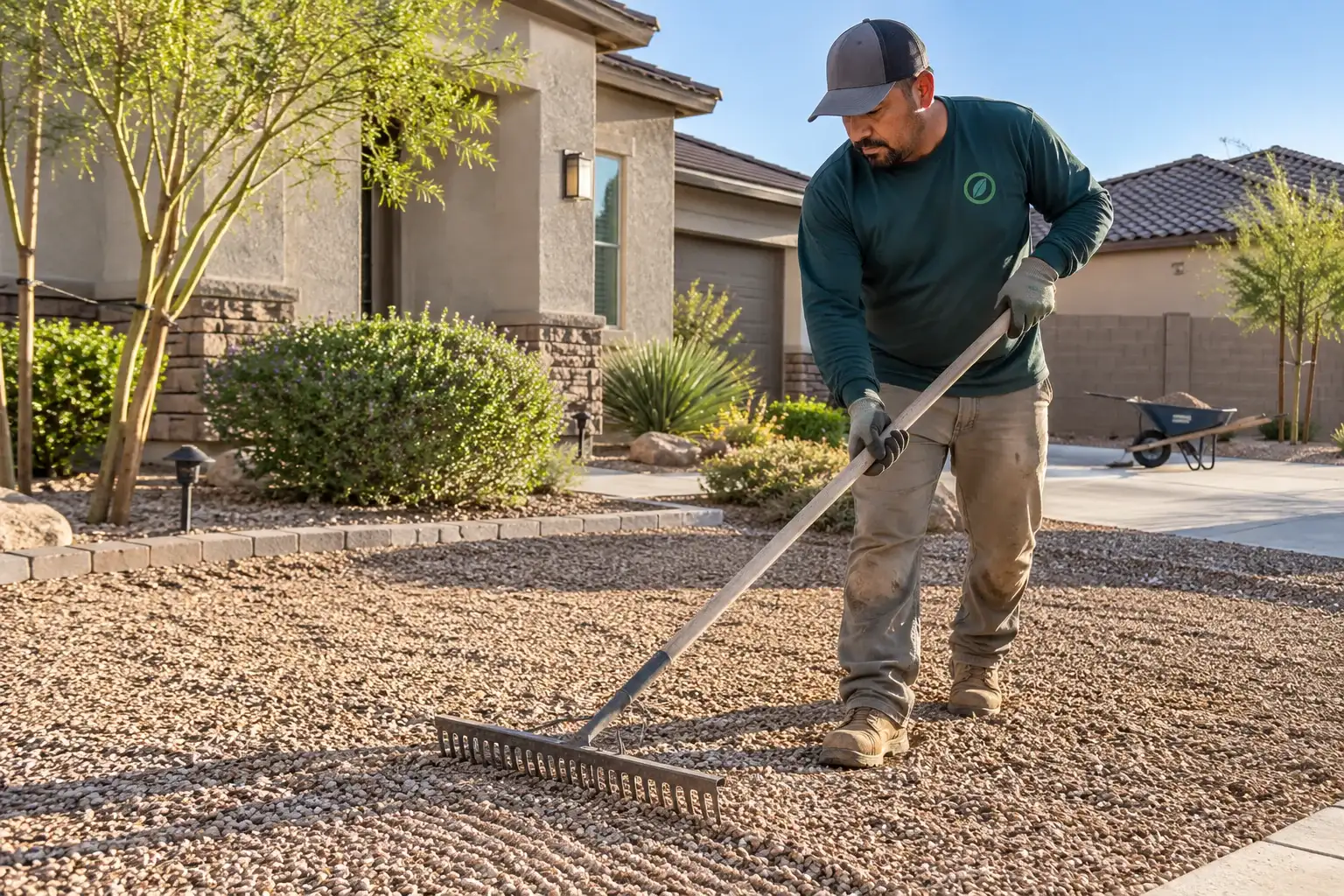
A small Chandler backyard feels bigger when the eye travels to one long line and stops at one thing, and when every plant is chosen at the size it will reach rather than the size it is in the pot. On a lot where the house, the fence and the patio already use most of the ground, the design work is mostly subtraction. Call (480) 658-2536 or send the form with the ZIP code and a rough size, and someone will call you back to go over the layout.
All yard guidesGood to know
Why does one small yard read bigger than another?
Depth and edges decide it, not area. A 400 square foot yard with one line running away from the house reads deeper than a 700 square foot yard cut into four pieces by a path, a planter and a change of material, because the eye measures the longest uninterrupted run before it measures anything else.
Chandler has more than 112,000 housing units and 71.7 percent of them are single family homes (City of Chandler (opens in a new tab)), and a single family lot arrives with the house already in the middle of it, a fixed side setback and a back fence at a set distance. You cannot add ground. You can add run: one surface, one direction, one place for the eye to land.
The other half is edge control. A yard reads tight when the boundary is busy, meaning pots, hose bibs, utility boxes, a shed, a clothesline and six plant species all within 20 feet of the seating area. Each one is a small stop. Ten small stops make a wall.
Good to know
Which three moves make a tight Chandler yard feel smaller?
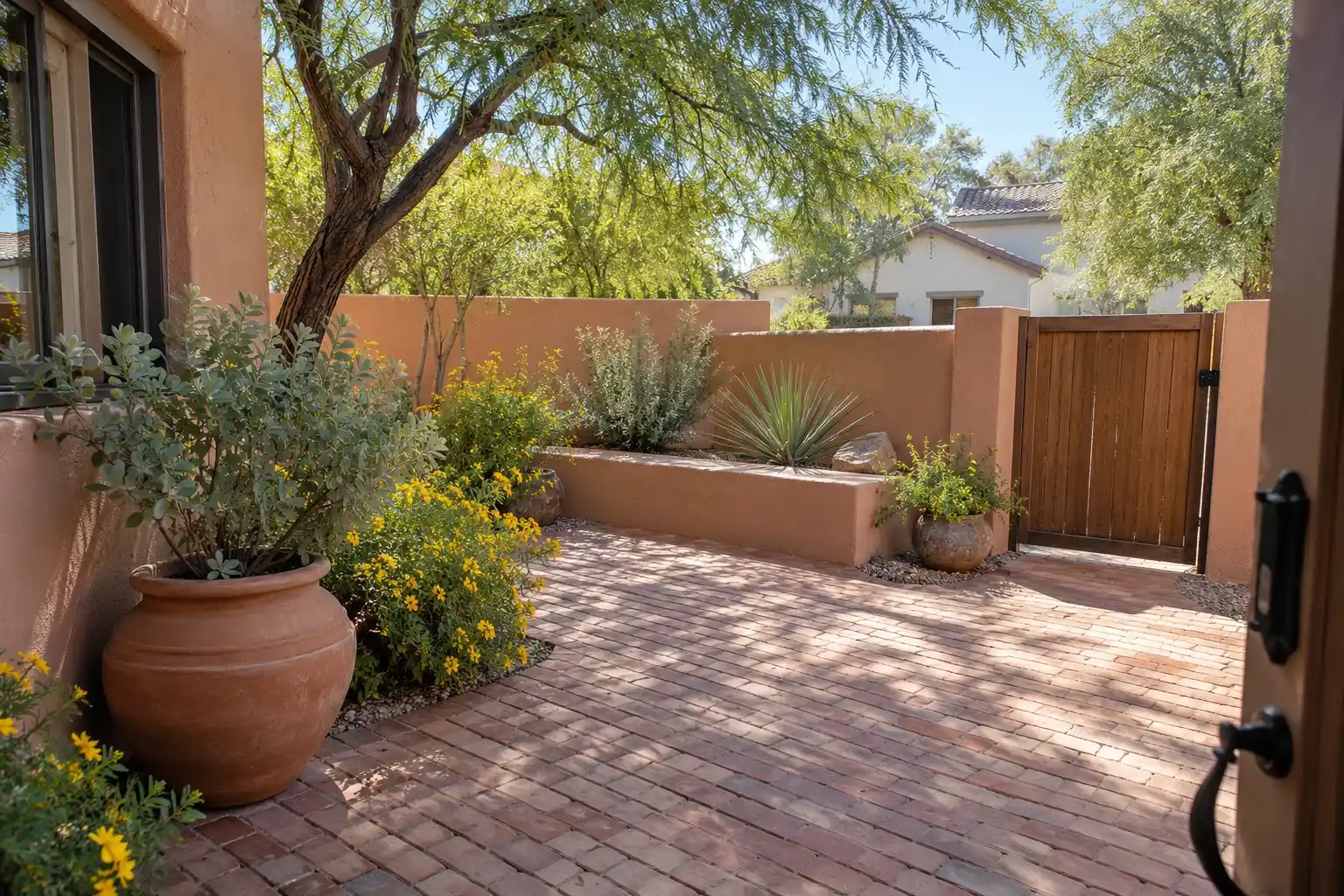
The three that do the most damage are the ring of pots around the patio, the path that cuts the yard in half, and the hedge of same-height shrubs along the fence with nothing above it. Each one is easy to add and each one shortens the yard in the eye.
| Move | What it does to the eye | The version that works |
|---|---|---|
| A ring of pots and furniture on the patio edge | Creates a fence of small verticals at knee and waist height | Two large pots at the corners, nothing between them |
| A path from the door to the far gate | Splits one space into two halves, and a half reads small | One path along the house, or stepping stones set wide and low |
| A hedge of one shrub at one height along the fence | Gives the eye a flat band with no depth behind it | Three heights: 2 ft, 6 ft and 15 ft, staggered |
| Gravel over the whole yard with plants in a single row | Reads as a parking strip, and the fence becomes the horizon | Gravel with a shaped bed, and one tree standing in it |
A large pot reads as furniture. Six small pots read as clutter, and clutter is what makes a yard feel like a storage area rather than a room.
Service area
How do you set the sight lines on a 30 foot wide lot?
Pick the view from the door people actually use, then decide what sits at the end of it. Stand in the doorway, look out, and mark the first thing the eye lands on. If that thing is the fence, the yard ends there, at 25 or 30 feet. If it is a tree at 15 feet tall with the fence behind it, the yard ends at the tree and the fence becomes background.
Then set a height ladder rather than a plant list. In a small yard the ladder needs three rungs: something at 2 feet to hold the ground, something at 5 to 6 feet to break the fence line, and one thing at 15 feet to lift the eye. The 15 foot rung is where a small yard spends its money, and it is the rung most often skipped because a tree looks too big in a 15 gallon box.
Good to know
Why do levels matter more than square feet?
A single step changes how a yard is read, because the eye registers the change in plane before it registers the distance. Twelve inches of rise at the back of the lot, done as a raised planter or a low seat wall, gives the far end a second room and makes the flat part in front of it feel like the main floor of a house.
The limit is drainage, not design. Water has to leave the yard and it has to leave away from the walls, so a raised area at the back is built with a swale, which is a shallow shaped channel that carries storm water around the planting rather than through it. The National Weather Service treats the monsoon as a June 15 to September 30 window (National Weather Service (opens in a new tab)), and a grade that has never been tested in a storm has not been tested at all.
Two levels are enough. Three levels in a 400 square foot yard turn it into a staircase, and every step is a place to trip.
Planting
Which plants fit when the bed is only 4 feet deep?
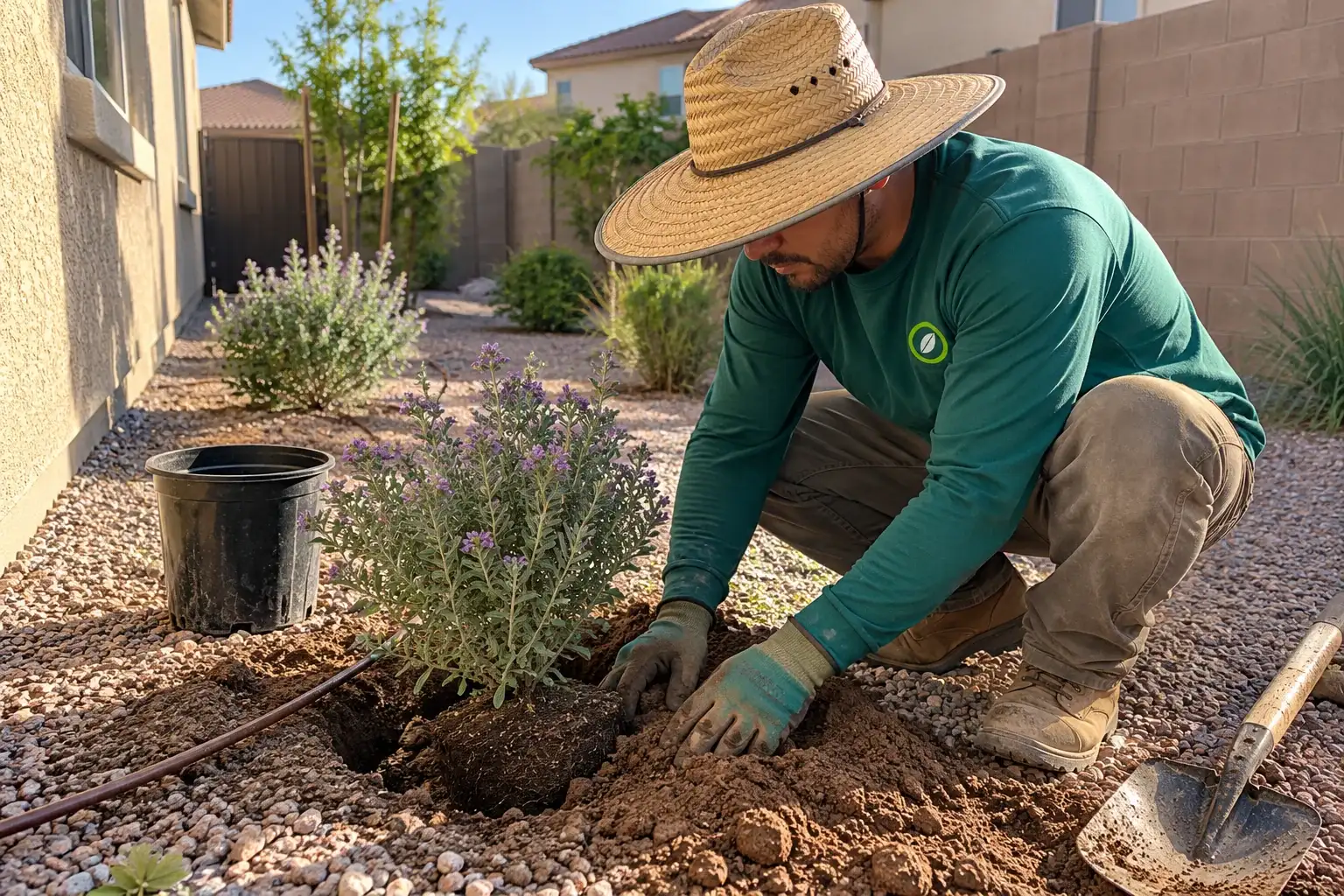
The rule that matters on a small lot is the mature width, not the mature height. A 6 foot wide shrub planted 3 feet from a wall grows 3 feet into the wall and 3 feet into whatever is in front of it, so the bed has to be as wide as the plant at full size or the plant has to be a narrower one.
| Plant | Mature height and width | Water | Where it goes |
|---|---|---|---|
| Foothills palo verde | 15 ft by 15 ft | Very low | The one tree, in the widest corner |
| Cascalote | 20 ft by 20 ft | Low | A yard with 20 ft of clear width |
| Desert willow | 25 ft by 20 ft | Low | The largest lot, near a drain or a lawn |
| Texas sage | 6 ft by 6 ft | Very low | A 6 ft bed along a fence |
| Red yucca | 3 ft by 5 ft | Very low | The strip between patio and wall |
| Damianita | 2 ft by 2 ft | Low | The 18 inch edge along a walk |
Sizes and water ratings come from the AMWUA plant pages listed under Sources. A row of five Texas sage at 6 feet wide needs 30 feet of bed, which is most of the width of a 40 foot lot, and that arithmetic is why a hedge of them closes a yard instead of framing it.
Choose the tree first and the shrubs around it. A foothills palo verde at 15 by 15 fits a corner that a blue palo verde at 30 by 30 would fill entirely, and the smaller tree still gives the 15 foot rung. The tree list for a tight lot is short, and the guide to small yard trees covers which roots behave near a patio.
Rules
What will the HOA approve on a small lot?
The package, not the idea. Most Chandler associations want a drawing that shows where turf, plants and hardscape land, a plant list with mature sizes, the wall or fence height, and where water drains. A plan that answers those four in one page moves through review faster than a photograph and a promise.
Approval is also the moment to decide about grass, because the numbers change the layout. Chandler's grass removal rebate is capped at $2,000 per property and needs at least 500 square feet of living grass converted, and artificial turf in that area does not qualify (City of Chandler (opens in a new tab)). Five hundred square feet is a 22 foot square, which is a useful unit on a small lot: a backyard of 1,500 to 2,000 square feet is three or four of those squares, so the conversion area is easy to picture before anyone measures it.
Read the recorded guidelines for your own subdivision rather than a neighbour's, because the plant list and the allowed gravel share differ from one association to the next. The step by step version is in the HOA approval guide.
Hardscape
Which surface makes a small yard read larger?
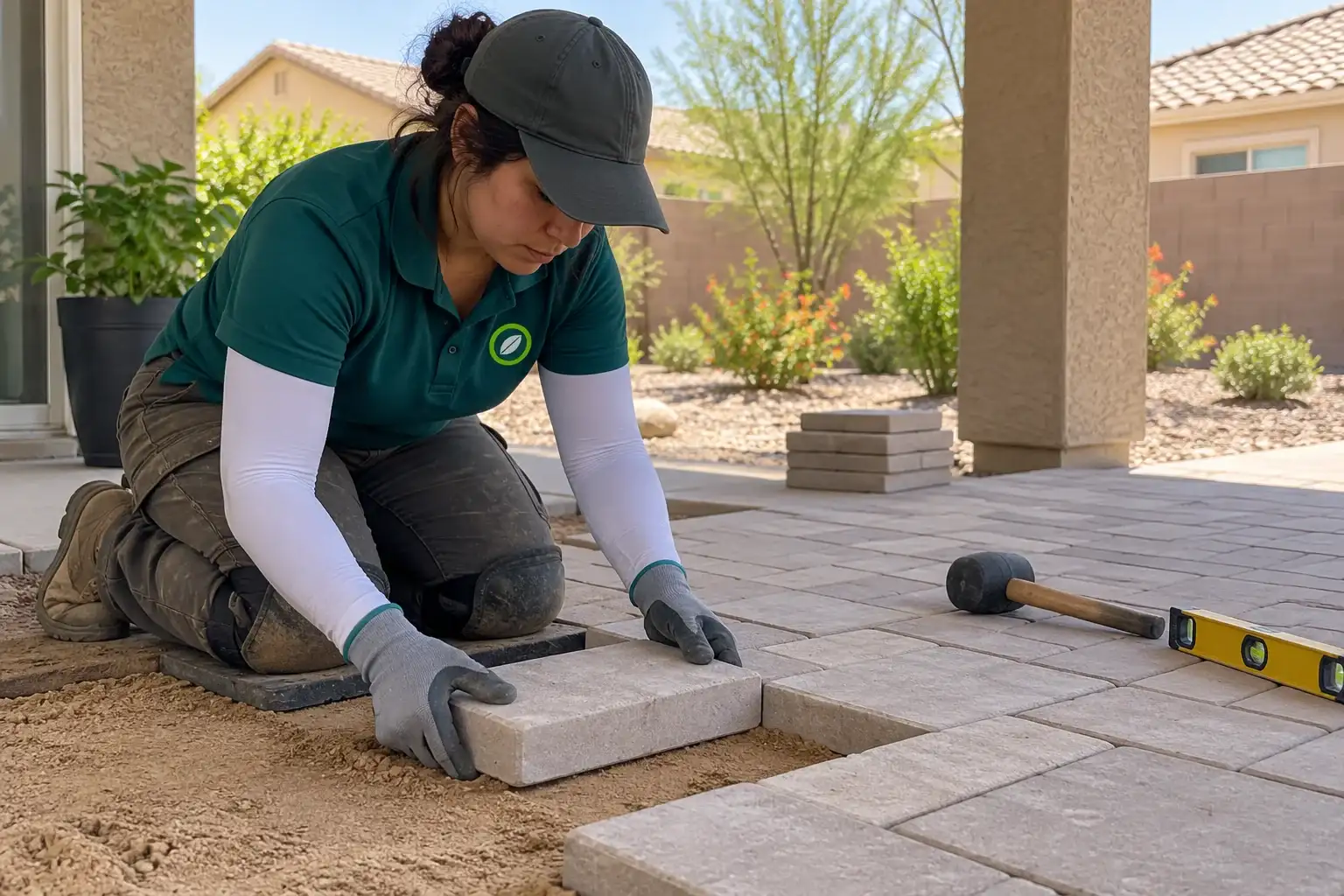
One pale surface, one direction, no border band. Pavers laid with the long joints running away from the house pull the eye outward, and a pale surface keeps the floor of the yard visually quiet.
A border band in a second colour is the most common mistake on a small patio. It draws a line across the width of the yard at the exact point where the space should be opening up. If the design needs a change of material, put it where a room would have a wall, not in the middle of the floor.
The base is the part that decides whether any of it lasts, and the paver and patio scope covers the base, the slope and the edge restraint.
6 steps
What order does the work go in?
Measure the yard and draw it at a quarter inch to the foot, including the fence, the hose bibs, the utility boxes and the door swings.
Send the drawing to the association with the plant list and the drainage note.
Set the grade and the drainage, because the finished surface height decides where the steps, the walls and the beds can go.
Run the irrigation in zones that match the planting, so the tree is not on the same valve as the 2 foot groundcover.
Lay the hardscape to the new grade.
Plant at the mature size on the drawing, then mulch and set the controller.
Planting is last because it is the only step that can be done twice without breaking anything. The four steps before it cannot.
Planning
What decides it for this yard?
Five things, and all five are read standing in the yard: where the afternoon sun lands, how deep the soil sits over the caliche, which way the ground falls, what the association allows in height and material, and the mature size of the tree that has to carry the 15 foot rung. Caliche is a subsoil layer that calcium carbonate has cemented into something closer to rock, so a planting hole that stops inside it holds water like a bucket (University of Arizona Extension (opens in a new tab)).
The on site read is also where the irrigation gets its run times. Chandler's own guide puts desert adapted trees and shrubs on a seven day interval in summer (City of Chandler (opens in a new tab)), which is a schedule a small yard can hold on two valves, and it is the reason the planting plan and the valve plan are drawn on the same page.
Call (480) 658-2536 or use the form and someone will call you back to walk the yard before the first plant is ordered. The landscape design scope is where the drawing, the plant list and the valve plan are put together.
4 questions
Questions people ask
Still have a question? Call (480) 658-2536 and describe the yard.
How big does a backyard need to be to feel usable?
Enough clear ground for a table and four chairs in one piece, plus the patio. Below that the room works as a courtyard for two chairs and a small table, and the design should stop pretending it is a lawn.
Should a small yard be all gravel?
No. Gravel is the plainest ground cover and the flattest thing the eye can land on, so a yard of nothing but gravel reads as a side yard. Gravel with a shaped bed, one tree and three heights of planting reads as a garden.
Does artificial turf make a small yard look bigger?
It makes it look greener, not bigger, and it does not count toward the Chandler rebate. Turf is worth its cost where people actually walk or sit on the ground, usually one shape near the door.
Can a small yard still have a tree?
Yes, and it should have exactly one. A foothills palo verde at 15 feet tall and 15 feet wide fits a corner and lifts the eye over the fence, which does more for the space than any amount of planting at 3 feet.
Sources
Sources
- City of Chandler, Housing in Chandler
- City of Chandler, Single Family Grass Removal Rebate Program Policy
- City of Chandler, Guide to Watering Grass, Trees and Shrubs
- University of Arizona Cooperative Extension, Managing Caliche in the Home Yard
- National Weather Service Phoenix, 2025 Monsoon Season Review
- AMWUA, Foothills palo verde
- AMWUA, Cascalote
- AMWUA, Texas sage
- AMWUA, Red yucca
- AMWUA, Damianita